Artificial marble slabs have become a practical surface material for residential interiors, hotels, commercial buildings, and decorative construction projects. They offer the visual appeal of marble with more controlled patterns, consistent colors, and flexible processing options. For architects, contractors, wholesalers, and property developers, choosing the right artificial marble is not simply about selecting an attractive color. It also involves understanding the material composition, slab quality, application requirements, and supplier capabilities.
How do you choose artificial marble slabs for a residential or commercial project? The most effective approach is to evaluate the intended application first, then compare the slab's appearance, dimensions, thickness, surface finish, physical properties, and maintenance requirements.
MRD Stone supplies artificial marble slabs in different colors and decorative styles, including pure white, super white, Emperador-inspired, and Calacatta-inspired designs. Its product range is intended for applications such as flooring, wall panels, kitchen countertops, bathroom vanity tops, and decorative surfaces.
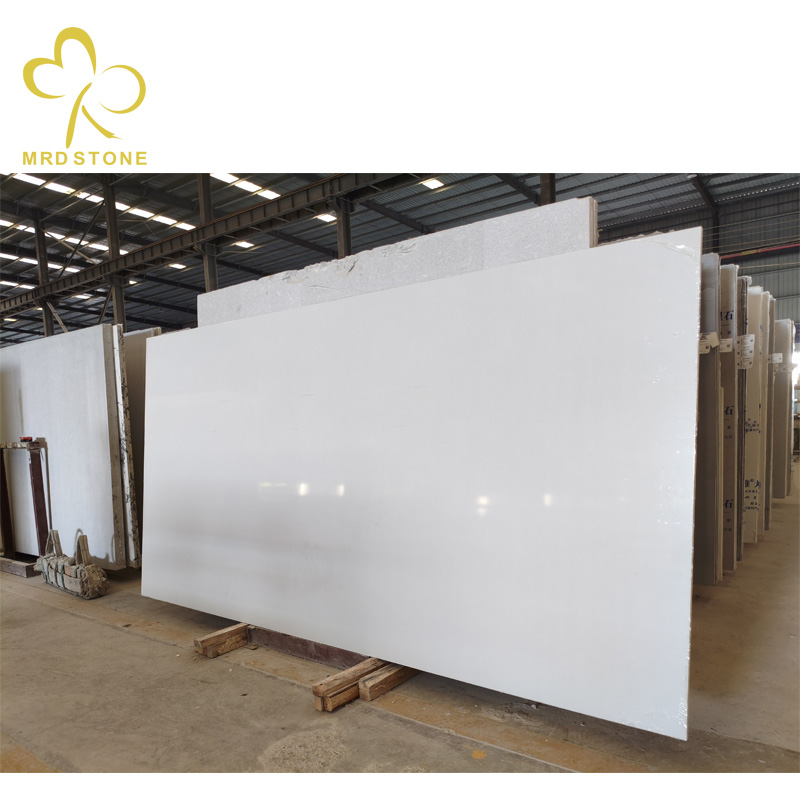
Pure white artificial marble slab for countertops, wall panels, and interior decoration.
Artificial marble, also known as engineered marble or composite marble, is a manufactured decorative stone material designed to reproduce the appearance of natural marble. Depending on the formulation, it commonly combines crushed natural marble or other mineral aggregates with resin binders, pigments, and additives.
During production, the raw materials are mixed, molded, compacted, and cured to create slabs with specific colors, patterns, and dimensions. The surface is then processed through grinding and polishing or other finishing methods according to the intended product design.
Compared with natural marble, artificial marble allows manufacturers to control decorative patterns and color distribution more consistently. This can be useful for projects that require several slabs with a similar visual appearance, such as hotel bathrooms, apartment developments, and large interior decoration programs.
However, artificial marble is not identical to natural marble or artificial quartz. Its performance depends on the raw materials, resin content, manufacturing process, and quality control. Buyers should always confirm the actual material composition and technical specifications rather than relying on the product name alone.
Artificial marble is selected for many interior projects because it combines decorative flexibility with practical processing advantages. It can reproduce the clean appearance of white marble, the depth of darker stone patterns, and other decorative effects while offering more predictable visual consistency.
Its main advantages include:
These advantages make artificial marble worth considering for hotels, residential developments, apartment buildings, office interiors, and commercial decoration projects. The actual suitability of a slab still depends on its technical properties and the conditions of use.
For buyers comparing different manufactured surfaces, MRD Stone also provides engineered quartz products. Comparing artificial marble and quartz can help project teams identify the most appropriate material for each application.
Color and pattern are among the first factors buyers consider when selecting artificial marble slabs. However, the choice should be based on the overall interior design, lighting conditions, furniture finishes, and the intended use of each surface.
Pure white artificial marble is suitable for minimalist interiors, modern bathrooms, hotel vanity tops, and bright residential spaces. Its clean appearance works well with neutral cabinetry, stainless steel fixtures, and light-colored wall finishes.
Calacatta-style artificial marble features a light background with more noticeable decorative veins. It can create a visual focal point in kitchen islands, reception counters, feature walls, and luxury-style interiors.
Emperador-style artificial marble generally features darker brown tones and contrasting veins. It can be used in spaces that require a warmer or more dramatic decorative effect, including hotel interiors, tabletops, and selected wall applications.
Black artificial marble is often selected for contemporary interiors, dark bathroom designs, decorative panels, and commercial reception areas. It can create contrast when combined with light-colored furniture and metallic details.

Artificial marble slab selection for consistent color and decorative design.
When purchasing artificial marble slabs in bulk, buyers should request actual product photographs or samples. Screen images may not accurately represent the finished slab's background color, vein contrast, gloss level, or surface texture.
It is also important to confirm whether the manufacturer can supply the required pattern consistently across the entire order. This is especially relevant for hotel projects, apartment developments, and commercial interiors that use the same material in multiple rooms.
The same artificial marble slab may not be suitable for every installation. A bathroom vanity top, a decorative wall panel, and a commercial floor have different requirements. Buyers should evaluate the material according to its intended use rather than choosing solely by color or price.
Kitchen countertops: Artificial marble can be considered for selected kitchen countertop applications, especially where a consistent decorative appearance is important. However, buyers should check heat resistance, stain resistance, water absorption, and resistance to household acids. Hot cookware should not be placed directly on the surface unless the manufacturer confirms that the product can withstand it.
Bathroom vanity tops: Artificial marble is commonly used for bathroom vanity tops, washbasin surrounds, and decorative bathroom surfaces. Buyers should confirm water absorption, moisture resistance, joint treatment, and compatibility with cleaning products.
Wall cladding: Artificial marble panels can provide a coordinated decorative appearance for hotel lobbies, residential feature walls, office reception areas, and interior corridors. Slab dimensions, weight, fixing systems, and substrate conditions should be considered during installation planning.
Flooring and tiles: Artificial marble can be processed into decorative flooring tiles for suitable interior applications. For high-traffic commercial areas, surface hardness, abrasion resistance, slip resistance, and maintenance requirements should be evaluated before specification.
Furniture and decorative surfaces: Tabletops, counters, shelves, and other decorative components can use artificial marble where the material's thickness and fabrication properties are suitable.
MRD Stone's artificial marble slab collection includes different decorative options for flooring tiles, wall panels, kitchen countertops, bathroom vanity tops, and tabletops. Buyers can review available designs and discuss the intended application before selecting a product.
Slab dimensions and thickness directly affect transportation, fabrication, installation, and the final appearance of a project. The correct specifications depend on the application, support structure, design details, and local installation practices.
When selecting artificial marble slabs, buyers should pay attention to the following factors:
For large commercial projects, it is advisable to finalize slab specifications before production begins. This helps reduce unnecessary cutting waste, material inconsistencies, and installation delays.
Artificial marble is often compared with natural marble and engineered quartz because all three materials can be used for decorative interior surfaces. However, they have different compositions and performance characteristics.
| Comparison Factor | Artificial Marble | Natural Marble | Engineered Quartz |
|---|---|---|---|
| Composition | Mineral aggregates and resin | Naturally formed rock | Quartz aggregates and binders |
| Appearance | Controlled marble-inspired designs | Unique natural veins | Consistent engineered patterns |
| Color Consistency | Generally consistent | Natural variations | Generally consistent |
| Acid Resistance | Depends on formulation | Generally sensitive to acids | Generally better than marble, but formulation-dependent |
| Heat Resistance | Depends on resin formulation | Generally good, varies by stone | Limited by resin binder |
| Typical Applications | Vanity tops, walls, tiles | Floors, walls, countertops | Countertops, backsplashes, interiors |
Artificial marble is a suitable option for buyers who want marble-inspired designs and more consistent decorative patterns. Natural marble is preferred when authentic geological textures and individual slab character are essential. Engineered quartz is often considered for countertops and other interior surfaces where hardness, low porosity, and everyday maintenance are important.
It is important to remember that none of these materials should be treated as identical. Buyers should compare the technical data of the actual product, particularly when selecting a material for kitchen or high-use commercial applications.
For projects that require a manufactured surface with different thicknesses and large-format decorative designs, MRD Stone also offers sintered stone slabs as another material option.
For importers, distributors, construction companies, and stone wholesalers, product quality is one of the most important purchasing considerations. A visually attractive slab does not necessarily guarantee consistent performance or easy fabrication.
Before confirming an order, buyers should review the following quality factors:
For larger orders, it is good practice to approve a sample or reference slab before mass production. Buyers should also agree on inspection criteria, acceptable tolerances, packaging standards, and procedures for handling damaged products.
Selecting the right artificial marble supplier is just as important as selecting the material itself. For international buyers, a reliable manufacturer should provide clear product information, stable quality control, suitable processing capabilities, and effective export coordination.
When evaluating a supplier, consider these important points:
MRD Stone is Xiamen-based and combines stone processing and international trading. Its product portfolio covers natural marble, granite, artificial marble, quartz, sintered stone, and other decorative stone materials. This allows buyers to compare different surface categories through one supplier when planning projects that require multiple material types.
For wholesalers, contractors, and project procurement teams, discussing the required color, slab dimensions, thickness, finish, quantity, and destination before ordering can make the purchasing process more efficient.
The right artificial marble slab should match both the visual requirements and practical conditions of the project. Pure white and light-colored patterns are suitable for bright, minimalist interiors, while darker and more dramatic designs can create contrast in hotels, commercial spaces, and feature areas.
For bathroom vanity tops and decorative wall panels, buyers should focus on moisture resistance, surface quality, and installation details. For kitchen countertops and high-traffic areas, it is particularly important to check heat resistance, stain resistance, mechanical properties, and maintenance requirements.
Before placing a bulk order, confirm the product specifications, inspect samples, and discuss packaging and delivery requirements with the manufacturer. These steps help reduce material selection risks and improve consistency across the project.
MRD Stone provides artificial marble slabs in different colors and styles for residential and commercial applications. Contact the team to discuss available designs, product specifications, and suitable material options for your next project.
What are artificial marble slabs made of?
Artificial marble slabs are generally made from crushed natural marble or other mineral aggregates combined with resin binders, pigments, and additives. The specific composition depends on the manufacturer's production process and product formulation.
Are artificial marble slabs suitable for kitchen countertops?
Artificial marble can be used for selected kitchen countertop applications, but buyers should confirm the product's heat resistance, stain resistance, water absorption, and resistance to household acids. Using trivets and suitable cleaning products is recommended.
Can artificial marble be used in bathrooms?
Yes. Artificial marble is commonly used for bathroom vanity tops, washbasin surrounds, wall panels, and decorative surfaces. Buyers should check the product's moisture resistance and follow the manufacturer's installation and maintenance recommendations.
What is the difference between artificial marble and natural marble?
Natural marble is quarried from the earth and has unique geological patterns. Artificial marble is manufactured using mineral aggregates and binders to create more controlled decorative designs and color consistency.
Is artificial marble better than quartz?
Neither material is always better. Artificial marble is often chosen for marble-inspired decorative patterns, while engineered quartz is commonly selected for its hardness and relatively low porosity. The best option depends on the intended application and the technical properties of the specific product.
How do I choose the right artificial marble slab thickness?
The required thickness depends on the application, support structure, slab dimensions, and fabrication method. Buyers should confirm the manufacturer's available thicknesses and obtain installation recommendations before ordering.
How can buyers check artificial marble quality?
Check surface appearance, color consistency, slab dimensions, thickness, polishing quality, and relevant physical performance data. For bulk purchases, approve samples and agree on inspection standards before production.
What colors of artificial marble are available?
Common options include pure white, super white, Calacatta-inspired patterns, Emperador-style brown, and black decorative designs. Actual colors and availability depend on the manufacturer's product range and production specifications.
How can I buy artificial marble slabs from MRD Stone?
Buyers can contact MRD Stone to discuss artificial marble designs, slab dimensions, thickness, surface finishes, order quantities, and export requirements. The company supplies different stone materials for residential and commercial projects.

XIAMEN MRD STONE CO., LTD